
Fisher & Paykel Healthcare: The Powerful Story Behind a NZ$2.3 Billion Medical Device Company
Fisher & Paykel Healthcare is a New Zealand medical-device company known for respiratory care, hospital systems and sleep apnea products. Here are its verified revenue, CEO, history, products, ownership facts and FY2027 outlook.

Introduction
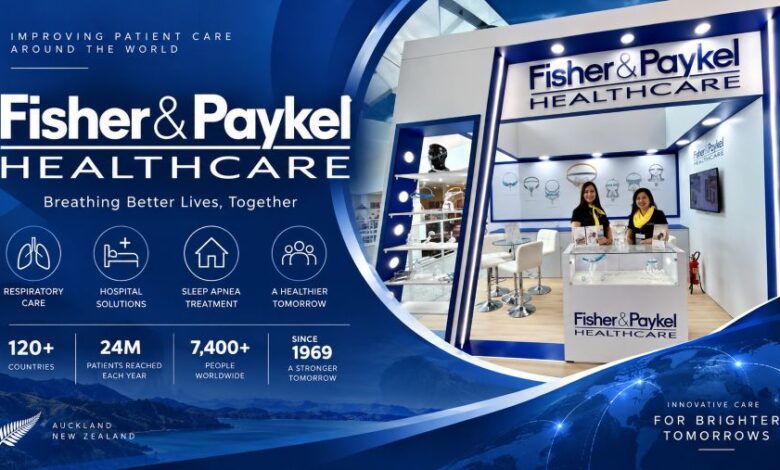
Fisher & Paykel Healthcare Corporation Limited is an Auckland-based medical-device company that makes respiratory-care, hospital, surgical and sleep-apnea products. It trades as FPH on the NZX and ASX. For FY2026, it reported NZ$2.3084 billion in revenue and NZ$468.5 million in net profit after tax. As of September 2026, Lewis Gradon is CEO.
The company sells products in more than 120 countries.
Its roots go back to 1969.
That is where the story starts.
Fisher & Paykel Healthcare Quick Facts
| Fact | Verified Detail |
|---|---|
| Full company name | Fisher & Paykel Healthcare Corporation Limited |
| Stock ticker | FPH |
| Industry | Medical devices |
| Medical business started | 1969 |
| Standalone healthcare company | 2001 |
| Headquarters | Auckland, New Zealand |
| CEO | Lewis Gradon |
| Chair | Neville Mitchell |
| CFO | Lyndal York |
| FY2026 revenue | NZ$2.3084 billion |
| FY2026 net profit | NZ$468.5 million |
| FY2026 R&D spending | NZ$235.5 million |
| FY2026 shareholders’ equity | NZ$2.1154 billion |
| FY2026 total dividend | 52 NZ cents per share |
| Countries served | More than 120 |
| FY2026 patient reach | About 24 million patients |
| Main business groups | Hospital and Homecare |
Key Numbers at a Glance
Here are the figures most readers are searching for.
- Revenue: NZ$2.3084 billion in FY2026
- Net profit after tax: NZ$468.5 million
- R&D spending: NZ$235.5 million
- Shareholders’ equity: NZ$2.1154 billion
- Permanent employees: 7,434
- Countries served: 120+
- FY2027 revenue guidance: NZ$2.47–2.57 billion
- FY2027 NPAT guidance: NZ$525–565 million
- CEO: Lewis Gradon
- Chair: Neville Mitchell
What Is Fisher & Paykel Healthcare?
Fisher & Paykel Healthcare is a New Zealand medical-device company that makes products used in respiratory care, hospitals, surgery and obstructive sleep apnea treatment.
The business is headquartered in Auckland.
Its shares trade under FPH.
The company sells medical products around the world, including respiratory humidification equipment, nasal high-flow systems, ventilation interfaces and CPAP masks.
It has two main commercial groups:
Hospital and Homecare.
Hospital is the larger one.
Homecare is heavily linked to sleep-apnea treatment.
Why Is Fisher & Paykel Healthcare Known?
Fisher & Paykel Healthcare is best known for respiratory humidification, nasal high-flow therapy, ventilation products and masks used in obstructive sleep apnea treatment.
Some of its recognised product families include:
- Optiflow
- F&P 950
- F&P 850
- Airvo 3
- F&P Solo
- F&P Evora
- F&P Nova
- F&P SleepStyle
These products are used in hospitals and homecare settings.
Respiratory care remains the main thread.
It has been that way for decades.
Is Fisher & Paykel Healthcare the Same as Fisher & Paykel Appliances?
No. Fisher & Paykel Healthcare and Fisher & Paykel Appliances are separate companies.
They share historical roots.
That causes confusion.
The healthcare business originally operated inside Fisher & Paykel Industries, but the healthcare and appliance operations were separated in 2001.
So today, Fisher & Paykel Healthcare is its own listed medical-device company.
The appliance business is separate.
That distinction matters.
How Did Fisher & Paykel Healthcare Start?
Fisher & Paykel Healthcare began as a medical operation inside Fisher & Paykel Industries in 1969.
The early work focused on respiratory humidification.
Intensive-care specialist Dr Matt Spence had seen problems caused by dry airways in mechanically ventilated patients at Auckland Hospital.
He worked with government electrical engineer Alf Melville and Fisher & Paykel engineer Dave O’Hare.
They built an early humidification system.
One prototype used a fruit-preserving jar.
Actually, yes.
A basic jar played a part.
The first Fisher & Paykel respiratory humidifier went on sale in 1970.
That small medical project later grew into a global company.
When Did Fisher & Paykel Healthcare Become Independent?
Fisher & Paykel Healthcare became a standalone healthcare business in 2001, when the healthcare and appliance operations were separated.
Before that, the medical side had already been growing for years.
By 1990, it had been renamed Fisher & Paykel Healthcare.
Company historical records put annual sales at roughly NZ$29 million around that period.
FY2026 revenue later reached more than NZ$2.3 billion.
That is a huge gap.
It shows the scale of growth.
What Products Does Fisher & Paykel Healthcare Make?
Fisher & Paykel Healthcare makes respiratory-care equipment, hospital systems, sleep-apnea masks, CPAP-related products and medical consumables.
Its product range is split across hospital and homecare use.
Hospital Products
Hospital products include systems used for:
- Nasal high-flow therapy
- Respiratory humidification
- Invasive ventilation
- Non-invasive ventilation
- Adult respiratory care
- Infant and neonatal respiratory support
- Anesthesia
- Surgical procedures
Products such as Optiflow, F&P 950 and Airvo 3 sit in this part of the business.
Infant-care products have included FlexiTrunk and Neopuff.
Sleep Apnea and Homecare Products
The company also makes masks and related products for obstructive sleep apnea.
Publicly marketed masks have included:
- F&P Solo
- F&P Evora Full
- F&P Evora Nasal
- F&P Nova Micro
- F&P Nova Nasal
- F&P Eson 2
- F&P Simplus
- F&P Vitera
The company also sells its F&P SleepStyle CPAP platform.
During FY2026, Fisher & Paykel Healthcare launched its F&P Nova Nasal mask in the United States.
How Much Revenue Does Fisher & Paykel Healthcare Make?
Fisher & Paykel Healthcare reported NZ$2.3084 billion in operating revenue for FY2026.
That financial year ended on 31 March 2026.
Reported revenue grew by about 14% from the prior year.
The company also reported NZ$468.5 million in net profit after tax.
Reported profit growth was about 24%.
Gross margin reached 63.7%.
Basic earnings per share came to 79.8 cents.
These are completed FY2026 figures.
They are not forecasts.
How Much Revenue Comes From the Hospital Business?
Fisher & Paykel Healthcare’s Hospital group generated about NZ$1.505 billion in FY2026 revenue.
Reported growth was around 18%.
Hospital consumables also grew during the year.
That matters for the business model.
Hospitals may buy systems and hardware first.
Then consumable products can be bought repeatedly.
So installed equipment can create continuing product demand.
How Much Revenue Comes From Homecare?
The Homecare business generated about NZ$802.7 million in FY2026 revenue.
Reported growth was around 8%.
Obstructive sleep apnea mask revenue rose by about 7%.
This gives Fisher & Paykel Healthcare a second large commercial base beside hospital products.
Which Region Makes Fisher & Paykel Healthcare the Most Money?
North America was Fisher & Paykel Healthcare’s largest reported geographic revenue market in FY2026.
Revenue by geography was:
| Region | FY2026 Revenue |
|---|---|
| North America | NZ$1.1061 billion |
| Europe | NZ$620.1 million |
| Asia Pacific | NZ$476.1 million |
| Other regions | NZ$106.1 million |
North America contributed close to half of group revenue.
That makes the US market especially important.
Trade policy matters here too.
More on that later.
Who Is the CEO of Fisher & Paykel Healthcare?
Lewis Gradon is the Managing Director and CEO of Fisher & Paykel Healthcare as of September 2026.
He took the role in April 2016.
Gradon already had a long history inside the company.
Before becoming CEO, he spent around 15 years as Senior Vice President of Products and Technology.
He had also worked for six years as General Manager of Research and Development.
He holds a Bachelor of Science in Physics.
His background is strongly tied to product and engineering work.
Who Is the Chair of Fisher & Paykel Healthcare?
Neville Mitchell is the Independent Chair of Fisher & Paykel Healthcare as of September 2026.
Mitchell has senior financial and board experience.
He previously served as CFO and Company Secretary of Cochlear.
Lyndal York is the company’s Chief Financial Officer.
Other senior executives lead operations, product development, technology, legal affairs and sales.
How Much Does Fisher & Paykel Healthcare’s CEO Earn?
Lewis Gradon’s total reported FY2026 remuneration was NZ$7.8077 million, but that figure was not simply salary.
His FY2026 remuneration included:
- Base salary: NZ$1,953,219
- Other benefits: NZ$31,539
- Annual variable remuneration: NZ$1,224,751
- Total cash-based remuneration earned: NZ$3,209,510
- Long-term variable remuneration realised: NZ$4,598,199
The long-term portion relates to incentives awarded earlier and realised after performance conditions.
So calling NZ$7.81 million his “salary” would be wrong.
What Is Fisher & Paykel Healthcare Worth?
Fisher & Paykel Healthcare reported NZ$2.1154 billion in shareholders’ equity at 31 March 2026. Its stock-market value was about NZ$26.2 billion around 4 September 2026.
Those figures measure different things.
Shareholders’ equity is an accounting figure.
Market capitalisation changes with the share price.
At 31 March 2026:
- Total assets: NZ$2.8536 billion
- Total liabilities: NZ$738.2 million
- Shareholders’ equity: NZ$2.1154 billion
FPH closed at NZ$44.84 per share on 4 September 2026.
Market data placed the company’s valuation near NZ$26.2 billion around that date.
That number can rise or fall daily.
So it should always carry a date.
Does Fisher & Paykel Healthcare Pay Dividends?
Yes. Fisher & Paykel Healthcare paid a total ordinary dividend of 52 NZ cents per share for FY2026.
That consisted of:
- Interim dividend: 19 cents
- Final dividend: 33 cents
The previous year’s total dividend was 42.5 cents per share.
The FY2026 final dividend was paid in July 2026.
How Much Does Fisher & Paykel Healthcare Spend on Research?
Fisher & Paykel Healthcare spent NZ$235.5 million on research and development in FY2026.
That was roughly 10% of operating revenue.
More than 960 people worked in clinical research, product development and process development activities.
These roles included engineers, scientists and physiologists.
R&D is a big expense.
And a big part of the company.
Medical equipment needs testing.
It needs clinical work too.
How Many Employees Does Fisher & Paykel Healthcare Have?
Fisher & Paykel Healthcare reported 7,434 permanent employees at 31 March 2026.
It also reported 227 temporary employees.
Staff work across:
- Manufacturing
- Research
- Clinical work
- Sales
- Technology
- Corporate functions
- International operations
The company still keeps a large New Zealand base.
Where Does Fisher & Paykel Healthcare Manufacture Products?
Fisher & Paykel Healthcare has major manufacturing operations in New Zealand and Mexico.
In an April 2025 company disclosure, the business said roughly:
- 55% of manufacturing volume came from New Zealand
- 45% came from Mexico
That was an April 2025 snapshot.
The mix can change.
So those percentages should not be treated as permanent.
What Is the East Tāmaki Campus?
East Tāmaki in Auckland is a major Fisher & Paykel Healthcare operating site used for product development, manufacturing and related work.
During FY2026, construction continued on a fifth building.
The new space is intended to support:
- Product development
- Manufacturing
- Warehousing
The company needs physical capacity.
It sells actual medical products.
So growth means more space.
What Is Fisher & Paykel Healthcare Building at Karaka?
Fisher & Paykel Healthcare owns about 105 hectares at Karaka, Auckland, for a planned second New Zealand campus.
The company agreed to buy the land in 2022.
The purchase price was NZ$275 million.
The Overseas Investment Office approved the deal in 2023.
Development is expected to happen slowly.
Very slowly.
The company has talked about a 30- to 40-year development period.
So Karaka is a long-term expansion project.
How Are US Tariffs Affecting Fisher & Paykel Healthcare?
US tariffs have created extra costs for Fisher & Paykel Healthcare because the United States is a major market and some hospital products sold there are made in New Zealand.
FY2026 gross margin included an estimated 90-basis-point constant-currency impact from US tariffs on hospital products sourced from New Zealand.
The company’s August 2026 outlook also included about NZ$23 million in US IEEPA tariff refunds.
Still, tariff exposure has not disappeared.
Management’s FY2027 guidance assumes current global tariff rates and policies continue through the financial year.
So investors keep watching it.
What Is Fisher & Paykel Healthcare’s FY2027 Forecast?
As of August 2026, Fisher & Paykel Healthcare expects FY2027 revenue of NZ$2.47–2.57 billion and net profit after tax of NZ$525–565 million.
For the six months ending 30 September 2026, the company expects:
- Revenue: about NZ$1.24 billion
- NPAT: about NZ$280 million
These are forecasts.
Not completed results.
The formal FY2027 half-year figures are expected in November 2026.
Who Owns Fisher & Paykel Healthcare?
Fisher & Paykel Healthcare is publicly owned through shares traded on the NZX and ASX.
There is no single private owner.
Large institutional investors have held substantial positions.
Around the FY2026 year-end period:
- BlackRock-related entities disclosed about 7.62%
- AustralianSuper disclosed around 7.07%
These holdings can change.
Shareholder percentages need dates.
Always.
Has Fisher & Paykel Healthcare Faced Legal Disputes?
Yes. Fisher & Paykel Healthcare has been involved in patent disputes linked to medical-device intellectual property.
One well-known case involved ResMed.
The two companies settled global patent litigation in 2019.
The settlement ended the proceedings with:
- No payment
- No admission of liability
- Each side covering its own legal costs
More recent European patent proceedings have involved Fisher & Paykel Healthcare and Flexicare.
These cases concern intellectual property.
They should not be treated as proof of misconduct.
What Does Fisher & Paykel Healthcare Do for Sustainability?
Fisher & Paykel Healthcare publishes environmental and social reporting covering areas such as greenhouse-gas emissions, water and environmental management.
For FY2026, publicly reported CDP scores included:
- Climate: B-
- Water: B-
The company also reports community support activity in several countries.
That has included programmes in Mexico, India and the United States.
Why Does Fisher & Paykel Healthcare Matter?
Fisher & Paykel Healthcare matters because it supplies respiratory and sleep-related medical products to healthcare systems in more than 120 countries.
Its FY2026 figures show the scale:
NZ$2.3 billion in revenue.
NZ$468.5 million in profit.
NZ$235.5 million in R&D.
More than 7,400 permanent employees.
About 24 million patients reached.
The company is still based in Auckland.
But its market is global.
Verified Interesting Facts
1. A fruit jar helped start the story
An early respiratory humidifier prototype used a fruit-preserving jar.
2. The medical business began in 1969
Fisher & Paykel Healthcare’s healthcare roots go back more than five decades.
3. The appliance business is separate
The healthcare and appliance operations split in 2001.
4. R&D spending passed NZ$235 million
The company spent NZ$235.5 million on R&D in FY2026.
5. Karaka is a decades-long project
The second Auckland campus may be developed over 30 to 40 years.
6. North America is its biggest region
FY2026 North American revenue reached NZ$1.1061 billion.
Final Thought
Fisher & Paykel Healthcare started small.
Very small.
Its first medical work centred on respiratory humidification in 1969.
Now the company sells healthcare products in more than 120 countries.
FY2026 revenue reached NZ$2.3084 billion.
Net profit hit NZ$468.5 million.
R&D spending reached NZ$235.5 million.
Those numbers tell the story clearly.
The business still focuses heavily on breathing, respiratory care and sleep-related treatment, but its scale is now far larger than the early humidifier project that started it all.
The next figure to watch is FY2027.
Management expects higher revenue and profit, but those numbers remain forecasts until the results are reported.
Frequently Asked Questions
What does Fisher & Paykel Healthcare do?
Fisher and Paykel Healthcare makes medical devices used in respiratory care, hospitals, surgery and obstructive sleep apnea treatment. Its products include humidification systems, nasal high-flow technology, ventilation interfaces, CPAP masks and related homecare products.
Is Fisher & Paykel Healthcare a New Zealand company?
Yes. Fisher and Paykel Healthcare is headquartered in Auckland, New Zealand. Its medical business began there in 1969, and it later became a standalone healthcare company in 2001.
Who is the CEO of Fisher & Paykel Healthcare?
Lewis Gradon is the Managing Director and CEO as of September 2026. He has held the role since April 2016 and previously worked in senior product, technology and R&D positions within the company.
How much revenue does Fisher & Paykel Healthcare make?
Fisher & Paykel Healthcare reported NZ$2.3084 billion in operating revenue for FY2026, the financial year ended 31 March 2026.
How much profit did Fisher & Paykel Healthcare make?
The company reported NZ$468.5 million in net profit after tax for FY2026.
Is Fisher & Paykel Healthcare the same company as Fisher & Paykel Appliances?
No. The healthcare and appliance operations share historical roots, but they were separated in 2001 and now operate as separate businesses.
What is Fisher & Paykel Healthcare’s net worth?
There is no single fixed “net worth” figure for the listed company. It reported NZ$2.1154 billion in shareholders’ equity at 31 March 2026, while its stock-market value was about NZ$26.2 billion around 4 September 2026.
Who owns Fisher & Paykel Healthcare?
Fisher & Paykel Healthcare is publicly owned by shareholders through shares listed on the NZX and ASX. Large institutional shareholders have included BlackRock and AustralianSuper.
Where are Fisher & Paykel Healthcare products sold?
The company says its products are sold in more than 120 countries.
How many employees does Fisher & Paykel Healthcare have?
At 31 March 2026, Fisher & Paykel Healthcare reported 7,434 permanent employees and 227 temporary employees.
What are Fisher and Paykel Healthcare’s main products?
Its main product areas include respiratory humidification, nasal high-flow therapy, ventilation interfaces, neonatal respiratory products, CPAP masks and sleep-apnea equipment.
What is Fisher and Paykel Healthcare’s FY2027 guidance?
As of August 2026, the company expects FY2027 revenue of NZ$2.47–2.57 billion and net profit after tax of NZ$525–565 million.